
Checking Criminal History in Cleveland
Cleveland has no single screen that combines police narratives, City Court citations, county bookings, felony dockets, and TBI history. The first question is what kind of Cleveland criminal record is needed. Use a report or incident number whenever possible. For a custody question, a full name and approximate arrest date can help the county jail locate the right booking.
- Start with Cleveland Police Records for a CPD incident, arrest, crash, or field-interview record. Ask which release rule applies to the exact product.
- Use Cleveland's formal public-records route for an existing CPD record not available through routine release. Give the incident number, date, location, record type, format, and cost limit.
- Check Cleveland City Court for a city citation, ordinance matter, traffic case, or city failure to appear. Do not treat its payment tool as a full history search.
- For current custody, call Bradley County Jail. For a state-law charge, use General Sessions first, then Circuit Criminal if a felony is indicted.
- Use TBI TORIS only for the Tennessee-reported history layer. Use TDOC FOIL when state felony custody or supervision is the actual question.
Each result should answer one defined question. Compare identifiers and dates before deciding that records from two Cleveland offices concern the same event.
Four Cleveland Criminal Record Custodians
Cleveland's role as the Bradley County seat puts several record offices close together, but it does not merge their files. City Hall coordinates city public-records requests. Cleveland Police owns CPD reports. Bradley County Jail creates booking and custody entries. The Bradley clerk owns the General Sessions and Circuit Criminal case files. Sending a request to the closest building can still produce a referral instead of the record.
Cleveland Police Records
100 Church Street NE
Cleveland, TN 37311
423-476-1121
Monday-Friday, 8 a.m.-5 p.m., excluding holidays
Cleveland City Court
Police Service Center
100 Church Street NE
423-559-3309
Court is held Thursdays; confirm the time
Bradley County Jail
2290 Blythe Avenue
Cleveland, TN 37311
423-728-7367
Current custody and booking information
Bradley Criminal Clerk
2230 Blythe Avenue SE
Cleveland, TN 37311
423-728-7050
General Sessions Criminal
The official City of Cleveland homepage provides the city-government entry point.
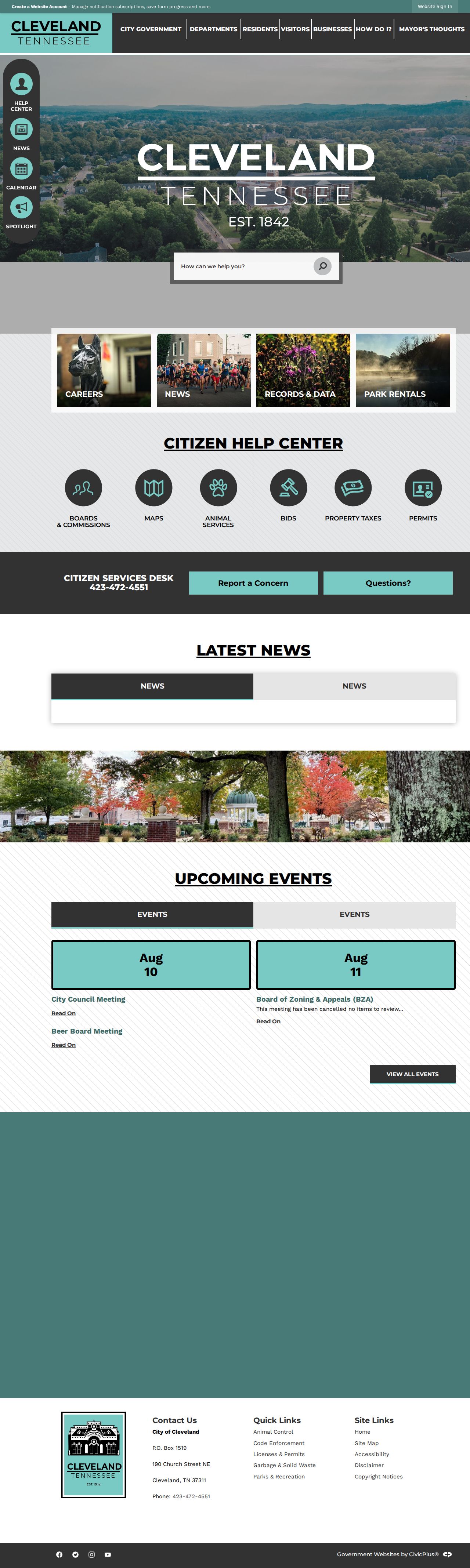
The city source routes municipal and police questions, while county custody and felony files remain with Bradley County offices.
Cleveland Police Department Records
The Cleveland Police Department creates electronic and handwritten offense reports, arrest reports, crash reports, and field interviews. Its Records Unit is the depository for those CPD products. Requests can be made in person, by phone, or by mail. A Cleveland police report is not stored at the Bradley clerk merely because the event later became a court case.
The official police page places the department within Cleveland's city services.

That department page should be used to confirm current contacts before a visit or request.
CPD release rules differ by product. Arrest reports are released only to the arrested individual who presents identification. Closed incident or offense files require approval from the district attorney or police chief, while active investigations are excluded. Crash reports may take three to five business days after the event. Accident photos route through the investigating officer at 423-476-1121; criminal-incident photos go to the district attorney at 423-472-2179; 911, phone, and radio recordings go to the Communications Manager at 423-478-8846.
The CPD Records Unit page states these routes and limits.
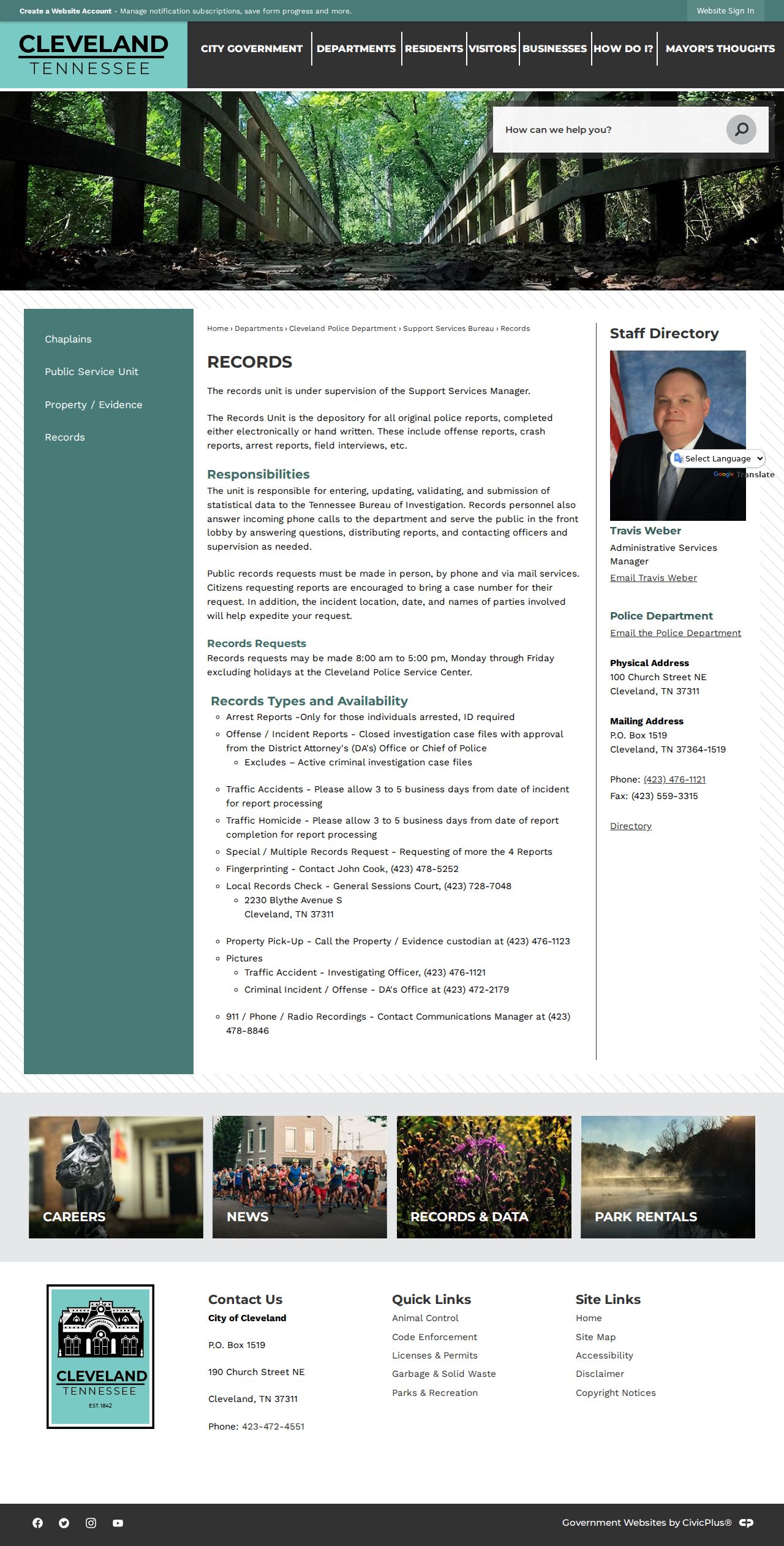
The named route matters because a general records request cannot erase the special release limits that apply to a specific Cleveland record.
Request Cleveland Police Criminal Records
Cleveland provides a formal public-records request route for existing city files. Its CPD request and certification form records the requester, desired access, delivery method, record details, and cost limit. A strong request names Cleveland Police as the department and describes the precise report, video, audio, or other record sought. The city's broader Document Center can be checked for the current form. Tennessee citizenship verification may apply under city policy.
The city request page shows the official path for a focused Cleveland criminal record request.
Using the Cleveland city route also keeps CPD material separate from sheriff, jail, and court records.
| Request field | How to complete it | Why it helps |
|---|---|---|
| Department | Cleveland Police Department | Routes the request to the correct city custodian |
| Record description | Name an existing report or medium | Prevents the request from reading like a general question |
| Incident number | Enter the exact CPD number if known | Provides the best local identifier |
| Date and location | Use a narrow event range and place | Reduces search time |
| Inspection or copy | Select the desired access and delivery | Clarifies whether staff must reproduce the file |
| Cost authorization | State a maximum before approval | Prompts an estimate above the chosen ceiling |
Cleveland Arrests and Bookings
After Cleveland Police makes an arrest, CPD keeps the city arrest narrative while Bradley County Jail keeps the booking and present-custody record. Call the jail at 423-728-7367 for current custody, booked charge, bond, hold, and court information. Then request the CPD report from the Records Unit. A sheriff booking record does not become a Cleveland police narrative, even though both files concern the same event.
The next official Cleveland record layer is usually General Sessions Criminal. A felony may begin there with an initial appearance and preliminary stage, then move to Circuit Criminal after grand-jury action. The Bradley County arrest lookup route gives the countywide booking and custody channels without changing who owns the Cleveland report.
Note: A booked charge is an intake allegation and may differ from the charge prosecutors file or the disposition the court later enters.
Cleveland Arrests Create Court Records
A Cleveland Police report number, a Bradley County booking number, and a General Sessions case number identify different stages. Match them with the person's correct name, incident date, arresting agency, and charge. If the General Sessions file shows a felony was bound over and later indicted, ask Circuit Criminal for the post-indictment docket. The two court divisions can both carry entries tied to one Cleveland arrest.
Cleveland record path: CPD report › Bradley booking › General Sessions Criminal › Circuit Criminal after indictment › TBI disposition reporting.
TORIS belongs at the end of this comparison. It is a Tennessee repository product built from reported arrest and disposition data, not a substitute for the detailed Cleveland narrative or Bradley docket. A person reviewing their own record should obtain the certified local disposition before challenging a mismatch in TBI history.
Municipal Court Records in Cleveland
Cleveland City Court handles matters in city and municipal jurisdiction, including city citations and traffic matters. The city's separate Municipal Court information route should also be checked when a saved city link changes. This court is not Bradley County Circuit Criminal Court and does not serve as a felony-history search. Court is held Thursdays at the Police Service Center. Municipal Court Clerk Km Bivens can provide the current session time at 423-559-3309.
| Court name | Cleveland City Court, also described by the city as Municipal Court. |
|---|---|
| Matters handled | Municipal-jurisdiction citations, ordinance matters, and traffic cases. |
| Record route | Official City Court page, municipal clerk, and court counter. |
| Payment tool | Municipal Online Payments handles eligible citations but is not a complete Cleveland criminal-history database. |
| County referral | A “large-sheet” ticket routes to the county Justice Center at 423-728-7048. |
Cleveland accepts in-person payments at 190 Church Street NE, Monday through Friday from 8 a.m. to 5 p.m., by cash, check, money order, or card. Mail goes to City of Cleveland, PO Box 1519, Cleveland, TN 37364-1519, with the citation number and no cash or counter checks. The drop box also needs a copy or number. No phone payments are accepted.
Cleveland Citations Stay or Move
A Cleveland citation stays at City Court when it is within municipal jurisdiction. Contesting the charge or proving insurance requires an appearance. The clerk may grant one extension before the assigned date; if an extension has already been given, the judge decides. A missed court date creates a default and a ten-day payment window before referral to the state. These city steps should not be confused with a state-law criminal case in General Sessions.
The Cleveland paper format can signal the next custodian. Local research identifies a “large-sheet” ticket as a county Justice Center matter. When uncertain, call the municipal clerk with the citation number before appearing or paying. A payment screen shows an amount due, not a full criminal record, the arrest narrative, or the final history held by TBI.
Where Cleveland Records Go
Records remain in the Cleveland office that created them even as related data moves onward. CPD preserves the report. Bradley County Jail creates the booking. General Sessions and Circuit Criminal build court dockets. TBI receives qualifying arrest submissions and later dispositions. No later step turns one file into another, so a thorough self-review compares the layers.
Record flow: Cleveland Police Department › Bradley County Courts › Tennessee Bureau of Investigation.
State and county systems should stay at routing depth on a Cleveland search. Use the Bradley County criminal court case page for the full clerk and docket process. Within Cleveland, use CPD for the narrative and City Court for municipal citations.
Cleveland Criminal Records by Numbers
TBI's official 2023 Crime in Tennessee report lists 4,770 Group A offenses reported by Cleveland Police, 1,920 cleared, and 2,008 arrests, including 1,767 adults and 241 juveniles. The agency population estimate used in that report was 48,885. Those figures describe CPD reporting under the program's rules. They are not counts of criminal histories, court cases, or unique people.
A Cleveland Police total must not be labeled as all of Bradley County. BCSO, Charleston Police, THP, and TBI may record their work under separate agencies. TBI also warns that arrest counts can concern incidents outside the same reporting period and that data may change. Use TBI CrimeInsight with Cleveland Police and an exact completed year selected before citing newer statistics; the FBI Crime Data Explorer is the secondary official comparison source.
Cleveland Records Reflect City History
Census QuickFacts for Cleveland and Bradley County supplies current place context without blending city and county figures. Cleveland became the Bradley County seat on January 20, 1838, took its name from Revolutionary War figure Benjamin Cleveland, and incorporated on February 4, 1842. That long municipal history helps explain why city records and county justice offices coexist in Cleveland. It does not make their custodians interchangeable. Modern CPD files remain city records, while adult county criminal counters are at the Blythe Avenue Judicial Complex.
The city's history also traces Cherokee place names and records that John Philip Sousa introduced “The Diplomat,” now the city song, at Craigmiles Opera House in 1906. Centenary Avenue and Ocoee Street historic districts entered the National Register in the 1990s. Historical research may therefore start with city archives, while a modern arrest or case must go to the active police, jail, or court custodian.
Public Access Rules in Cleveland
The Tennessee Public Records Act applies to qualifying requests for existing Cleveland government records unless another law makes material confidential. Inspection is free under the city's published procedure. Black-and-white letter copies cost $0.15 per page, color copies cost $0.50 per page, and labor beyond the first hour may be charged at the assisting employee's hourly wage after an estimate. Ask for the nonexempt part when protected details require redaction.
The city's open-records procedures explain the local policy and charge framework.
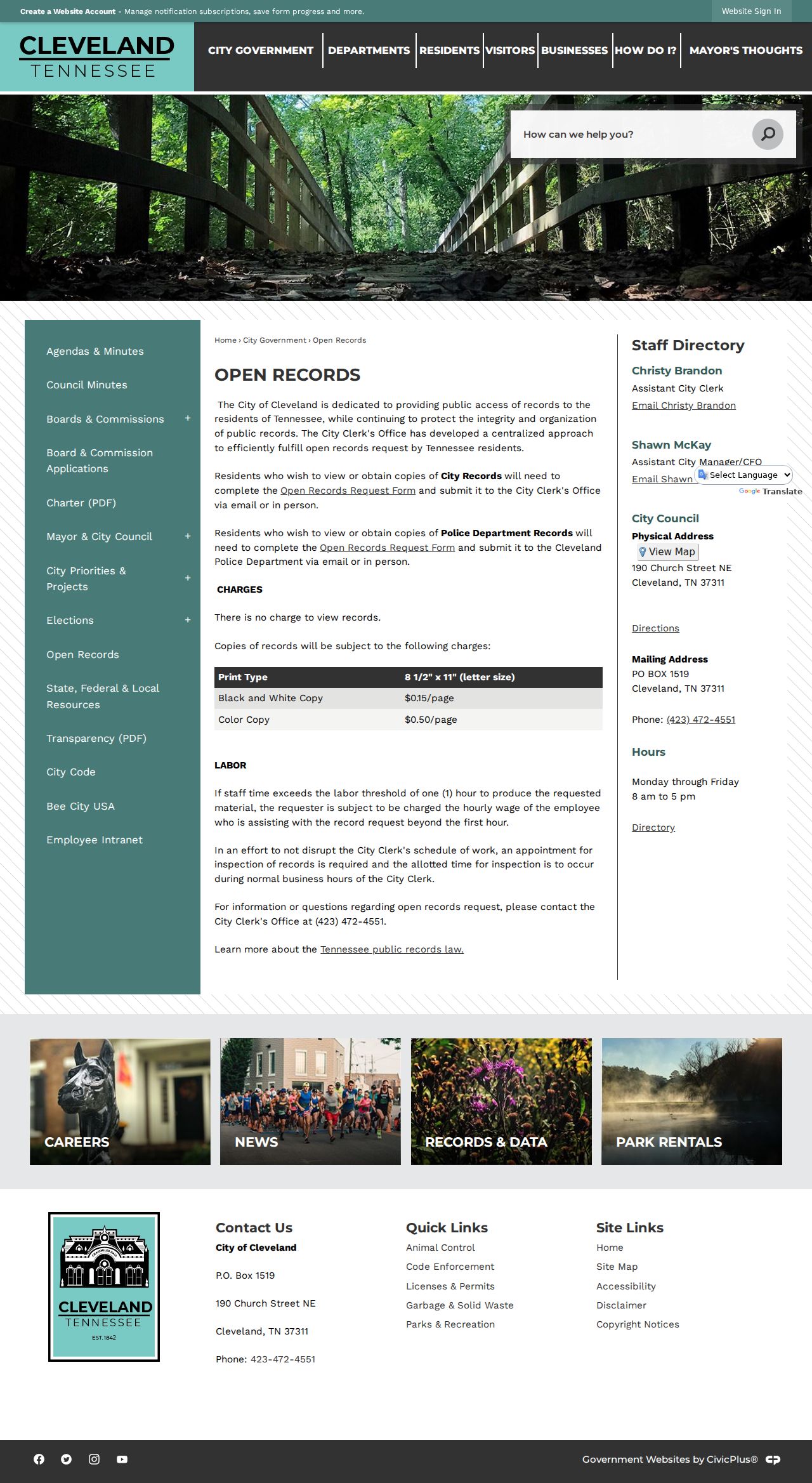
Those procedures govern city-held material; Tennessee Supreme Court Rule 34 separately governs access policy for court records.
Key statutes:
Tennessee Public Records Act, Tenn. Code Ann. § 10-7-503 presumes access to qualifying government records subject to lawful exceptions and policy.
Tenn. Code Ann. § 10-7-504 protects specified confidential records and sensitive identifiers.
Tennessee Supreme Court Rule 34 sets the policy for public access to court records, with sealing and redaction limits.